
Create moving invoices and e‑invoices
After the move, the invoice should reach the customer quickly – correct, easy to follow and without retyping anything. Xlado generates the moving invoice from the quote and job in one click: as a PDF on your letterhead or as an e‑invoice in XRechnung format for public-sector clients.
- Line items, prices and customer data taken over automatically
- XRechnung with Leitweg-ID for German authorities and the Bundeswehr
- Invoices and credit notes in seconds – even at the customer's home
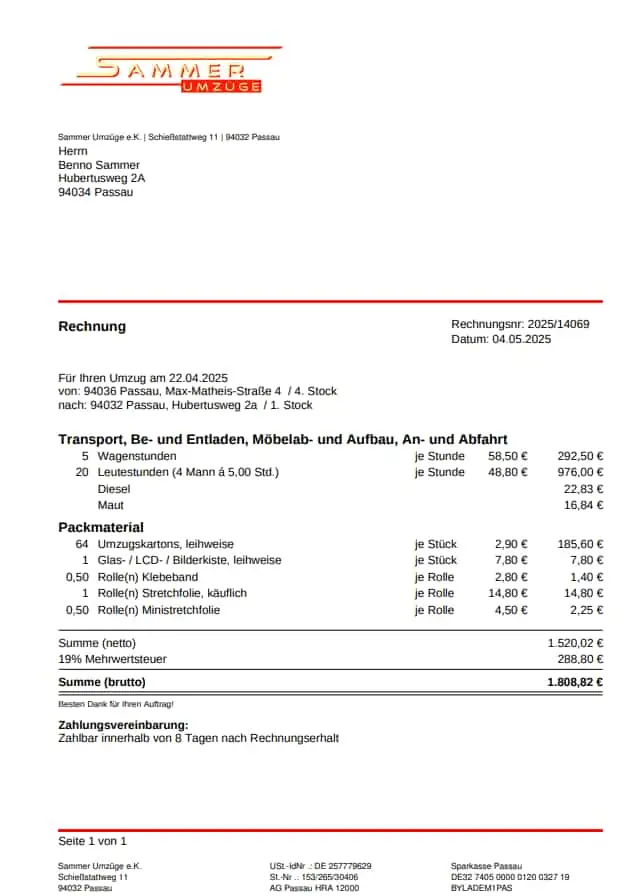
The invoice is created from the quote
Whatever is in the quote and the moving inventory does not have to be entered again for the invoice. Xlado takes over line items, prices and customer data; you only adjust what changed during the move – such as the actual hours or extra packing materials.
This is how Xlado connects quoting, dispatch and billing into one continuous workflow with consistent data.
- Invoices and credit notes as PDF in seconds
- Flexible templates, e.g. local, long-distance, fixed-price move
- Your own letterhead (PDF) or pre-printed stationery
- Number ranges and reusable text blocks
- Automatic email sending and archiving
- Can be created right at the customer's home
What belongs on a moving invoice
Mandatory details (German VAT Act, § 14 UStG)
- Name and address of your company and of the customer
- Tax number or VAT identification number
- Date of issue and sequential invoice number
- Type and scope of the service
- Date of service, i.e. the moving date
- Net amount, tax rate and tax amount
What else makes a moving invoice clear
- Loading and unloading address, ideally with floor
- Truck hours and labour hours with the number of movers
- Packing materials, split into rented and purchased
- Additional costs such as diesel or tolls
- Payment terms, e.g. “payable within 8 days”
Tip for private customers in Germany: the labour costs of a move can be claimed for tax purposes as household-related services. For that, they should be identifiable on the invoice – for example as separate line items for labour hours.
XRechnung with Leitweg-ID for public-sector clients
German authorities, municipalities and the Bundeswehr only accept invoices as e-invoices. The Leitweg-ID (routing ID) makes sure the invoice reaches the right office. Xlado creates XRechnung invoices including the Leitweg-ID directly from the job – no extra program needed.
XRechnung follows the European standard EN 16931 and is therefore also a valid e-invoice format for business customers.
Typical public-sector clients in the moving business
- Relocations of German Armed Forces (Bundeswehr) personnel
- Office relocations for public administrations
- Schools, hospitals and municipal facilities
For companies with Bundeswehr and long-distance moves: software for removals companies.
E-invoicing mandate: what applies to moving companies in Germany?
For invoices to other businesses (B2B) within Germany, e-invoicing is becoming mandatory step by step. Invoices to private customers – i.e. most household moves – are not affected.
| From | What applies (B2B, domestic) |
|---|---|
| 1 January 2025 | All businesses must be able to receive e-invoices. |
| 1 January 2027 | Businesses with a prior-year turnover above €800,000 must issue e-invoices. |
| 1 January 2028 | All businesses must issue e-invoices in the B2B sector. |
A PDF file is not an e-invoice in the legal sense. This overview is not tax advice – your tax adviser can clarify what applies to your company in detail.
FAQ: moving invoices
More answers in the Xlado FAQ.
What must a moving invoice include?
Besides the mandatory details – names and addresses of both parties, tax number or VAT ID, invoice date, sequential invoice number, type and scope of the service, date of service, net amount, tax rate and tax amount – a moving invoice should also show the moving date, the loading and unloading addresses and the individual line items such as truck hours, labour hours and packing materials.
Can Xlado create e-invoices in XRechnung format?
Yes. Xlado creates e-invoices in XRechnung format including the Leitweg-ID, as required by German public-sector clients such as authorities or the German Armed Forces (Bundeswehr).
When do moving companies in Germany have to issue e-invoices?
For business-to-business invoices within Germany: since 2025 all businesses must be able to receive e-invoices. From 1 January 2027, businesses with a prior-year turnover above €800,000 must issue e-invoices, and from 1 January 2028 all businesses. Invoices to private customers are not affected. Your tax adviser can clarify the details for your company.
Is a PDF invoice an e-invoice?
No. An e-invoice in the legal sense is a structured data record according to the European standard EN 16931, for example an XRechnung. A PDF is an “other invoice” – still perfectly fine for private customers.
Can I use my own letterhead?
Yes. Invoices can be issued on your own letterhead as a PDF or printed on existing pre-printed stationery. Number ranges and reusable text blocks can be configured.
Your next invoice in one click
Quoting and invoicing are included in the free basic plan. Questions about XRechnung? Give us a call: +49 851 9860204
Get started for free